
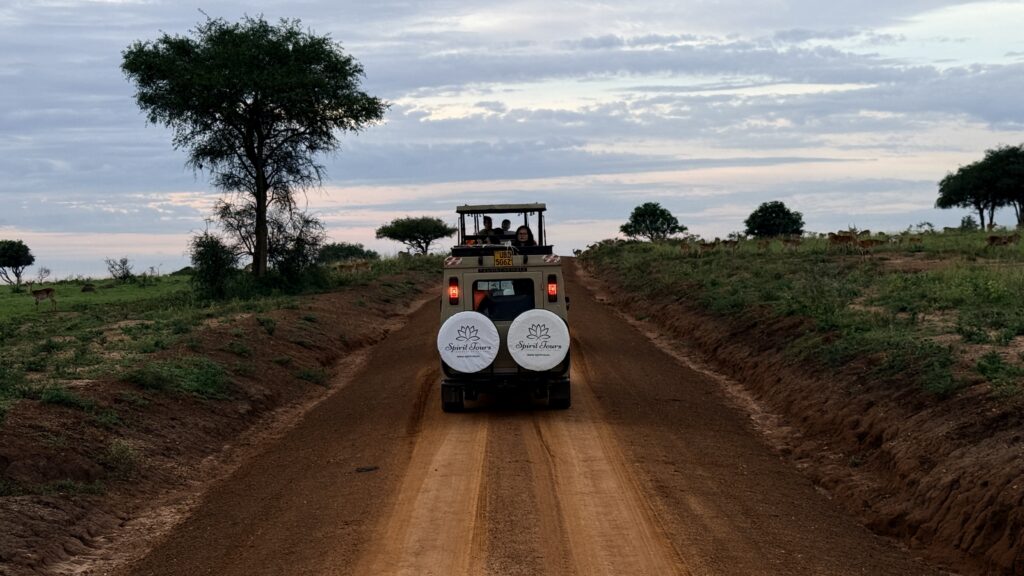
When I first signed up for Spirit Tours’ Sacred Journey to Uganda, I imagined myself standing on a mountainside watching a silverback emerge from the mist. I imagined elephants grazing across endless grasslands and hippos surfacing in the Nile. I imagined checking items off a bucket list I had carried in my imagination for decades.
And all of that happened. The gorillas exceeded every expectation. The safaris were extraordinary. Murchison Falls thundered with a force that seemed to rise from the earth itself.
Yet somewhere along the way, the journey quietly transformed into something else. What stayed with me was not simply what I saw. It was what I began to understand.
Before leaving, I wrote myself a simple affirmation: I honor what I am walking into. I am here to witness, feel, receive, and be changed. At the time, I thought I was speaking about Uganda. Now I wonder if I was speaking about consciousness itself.
This Spirit Tours Sacred Journey to Uganda was created as an exploration of the evolution of consciousness. As I reflected on the experience, I found myself asking: What if consciousness is not a single thing? What if there are many forms of consciousness waiting to awaken within us?
Again and again, Uganda invited me into deeper relationship: with nature, with community, and ultimately with life itself.
Ecological Consciousness: Life Beyond the Human Center
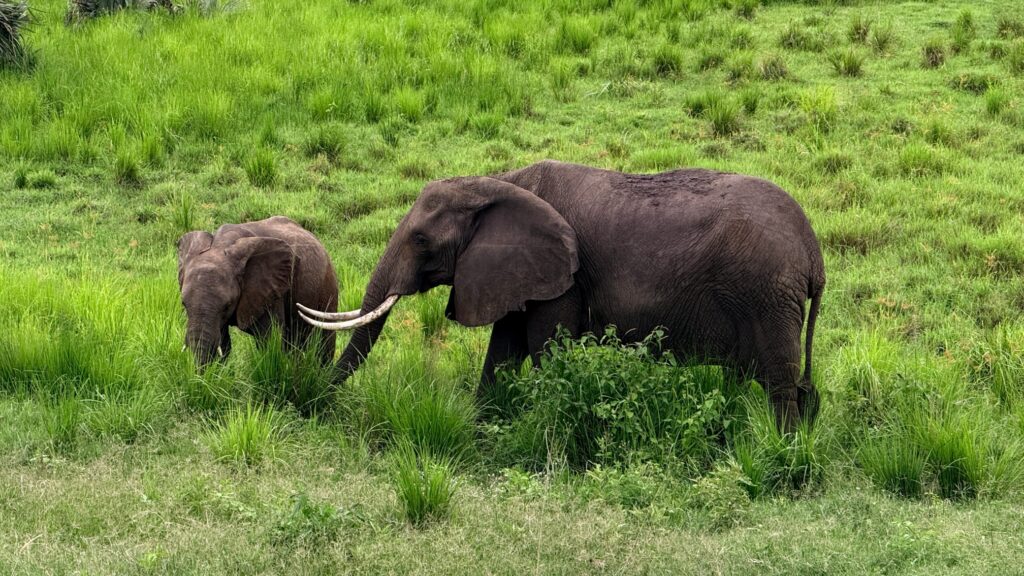
The first surprise was how quickly excitement gave way to reverence. As our jeep rolled to a stop in the grasslands, the chatter faded. A warm breeze moved through the open roof. Somewhere in the distance, an elephant tore another mouthful of grass while birds stitched together the morning with song.
We grew silent. Perhaps listening is the better word.
As our jeep sat motionless in the grasslands, the world became more textured. Birdsong, wind, fresh grass, and the distant calls of animals all became easier to notice. Life was humming in every direction.
Gradually, something shifted. Being human was no longer the center of the story.
Life was already happening. Life was already complete. We were simply visitors. At one point I found myself thinking: We are the curiosities here.
In turn, that realization felt strangely liberating.
Modern life encourages us to see ourselves as managers, controllers, and problem-solvers. We move through the world assuming our concerns occupy the center of reality.
Out on the savannah, a different perspective emerges. Species upon species eat, sleep, raise young, communicate, and coexist in an intricate dance that has been unfolding long before our arrival.
Life already knows how to live. The animals are not searching for meaning. They are living it.
Yet wildlife was only the doorway. The lesson was about belonging.
Ecological consciousness invites us to remember that we are not separate from nature. We are expressions of it.
Kinship Consciousness: Looking Into Familiar Eyes
Nothing prepared me for the gorillas.
Not because of their size. Not because of their strength. And not even because of their remarkable similarity to us. What surprised me most was their tenderness.
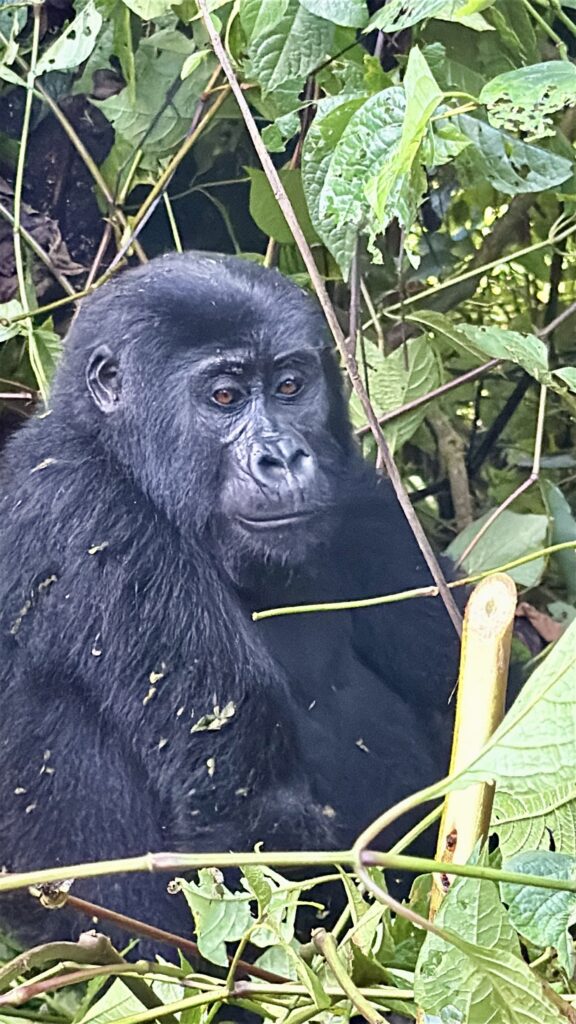
After a steep climb into Bwindi Impenetrable Forest, our group finally reached the spot where the Rushegura Gorilla Family had been spotted eating and resting in the brush.
One young gorilla sat beside the trail casually eating lunch as though we were unusual ones. Nearby, a silverback seemed quietly aware of our presence. He studied us for a while, then returned to lounging, rolling onto his back like an oversized child enjoying a lazy afternoon.
Two brothers chased one another through the brush, tumbling and wrestling before collapsing together in a heap. At one point the older sibling delivered a dramatic chest beat, apparently quite impressed with himself.
Then I watched a mother hold her infant close against her chest. The moment lasted only seconds. Yet it felt timeless. Tenderness requires no translation.
Subscribe to our newsletter for twice-monthly reflections, spiritual travel insights, and first looks at new tours.
The Boundaries Soften
As the family moved through the forest, I found myself recognizing something deeply familiar. The protective instincts of a mother. The playful rivalry between siblings. The watchful presence of a father. The comfort of belonging within a group.
Beneath the physical resemblance lay something even more powerful than the genetic connection. It was the emotional one.
Watching the mountain gorillas stirred the same tenderness I have felt while holding my dogs and cats. The same protective love. The same sense of wonder.
For a moment, the categories that usually separate us seemed less important: human, animal, observer, observed. The boundaries softened.
Kinship consciousness is not about denying differences. It is about recognizing relationship. It is the awareness that life expresses itself through countless forms while remaining connected at a deeper level.
Standing among the gorillas, I found myself wanting to move beyond observation. I wanted to sit quietly among them, to feel seen, and to belong.
Relational Consciousness: Obuntu in Practice
Throughout the day, I found myself thinking about Obuntu, a Ugandan expression of the Ubuntu philosophy often summarized as “I am because we are.”
If the gorillas awakened kinship consciousness, the people of Uganda awakened relational consciousness.
Helping Hands
Again and again throughout the journey, helping hands appeared before they were needed.
When the terrain became difficult during chimpanzee trekking, the ranger Sharon took my hand. When steep trails challenged my balance, porters steadied me. And when our jeeps arrived at Murushasha Community School, children rushed forward to help us navigate the path.
No hesitation. No fanfare. Just generosity.
At first, I noticed these moments individually. Yet over time, I began to see the pattern. Community was not something discussed. It was something practiced.
A Welcome Like No Other
Nowhere was this more visible than Murushasha.
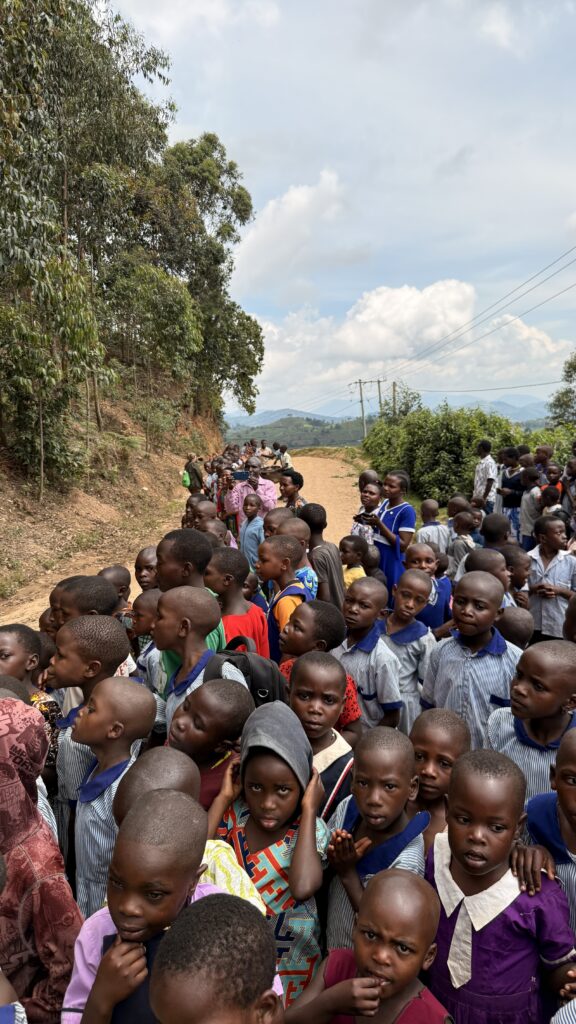
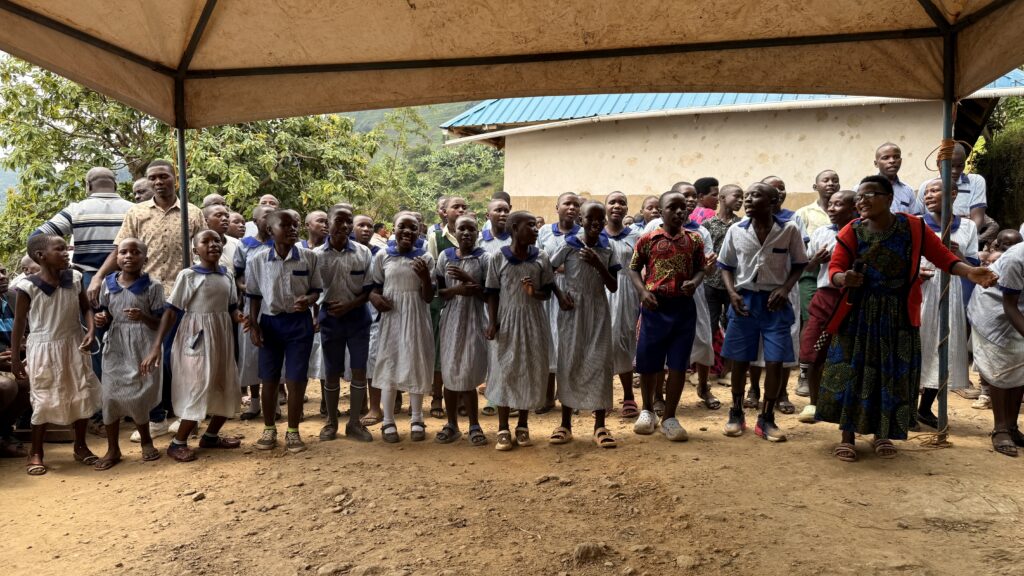
As our vehicles approached the school, we heard distant voices. Then the children came into view: hundreds of them, singing, waving and smiling as wide as the savannah.
As the jeeps pulled closer, they surrounded us in a joyful procession while drummers kept rhythm from the rear of the line. Before long we were dancing too.
Parents gathered. Teachers smiled. Drums echoed through the hills. What struck me most was how quickly the distinction between host and guest seemed to dissolve.
We had arrived as visitors. Yet within moments, we were participants in the celebration.
The children weren’t performing for tourists. They were welcoming friends. That distinction matters.
Throughout the day, I never felt like an observer standing outside the experience. I felt invited into it.
Spirit Tours has supported the Murushasha school for several years through sponsorships, donations, and fundraising efforts. Yet what moved me most was the affection between Rev Karen and the children, the pride of the teachers, and the participation of the entire community.
Later, almost five hundred children lined up patiently for lunch. Parents gathered beside the tent; elders took seats under the shade. Community leaders shared updates and hopes for the future. Everywhere I looked, I saw evidence that the school belonged to the community itself.
There was pride here. Not the pride of accomplishment alone, but the pride that comes from building something together.
Classrooms, programs, meals, opportunities, and relationships were all part of the same living fabric. The school was not simply serving the community. It was an expression of the community.
More Than a Philosophy
As the day unfolded, I began to recognize what Obuntu looks like when it moves beyond philosophy and into practice.
In the West, we often define ourselves through individual accomplishments and independence. Obuntu offers another possibility. Identity emerges through relationships. We become ourselves through our connections with others.
Even one of the children’s songs, proudly sung by preschoolers through adolescents, contained the lyrics “I am what I am, because of you.”
This was not an abstract philosophy in Uganda. It was visible everywhere.
I saw it in Sharon’s hand in the forest, in the porters attending us on every trek, and in children helping us navigate the path to the school. I saw it in women greeting strangers with song and in teachers dedicating themselves to hundreds of students.
Different people. Different circumstances. The same impulse.
We help one another because our lives are intertwined.
Participatory Consciousness: Allowing the Journey to Touch Us
There was another thread running quietly through the journey: participation.
Before leaving home, I worried about my physical limitations. The affirmation I wrote reflected those concerns. “My body is not coming along for the journey. She is leading it.“
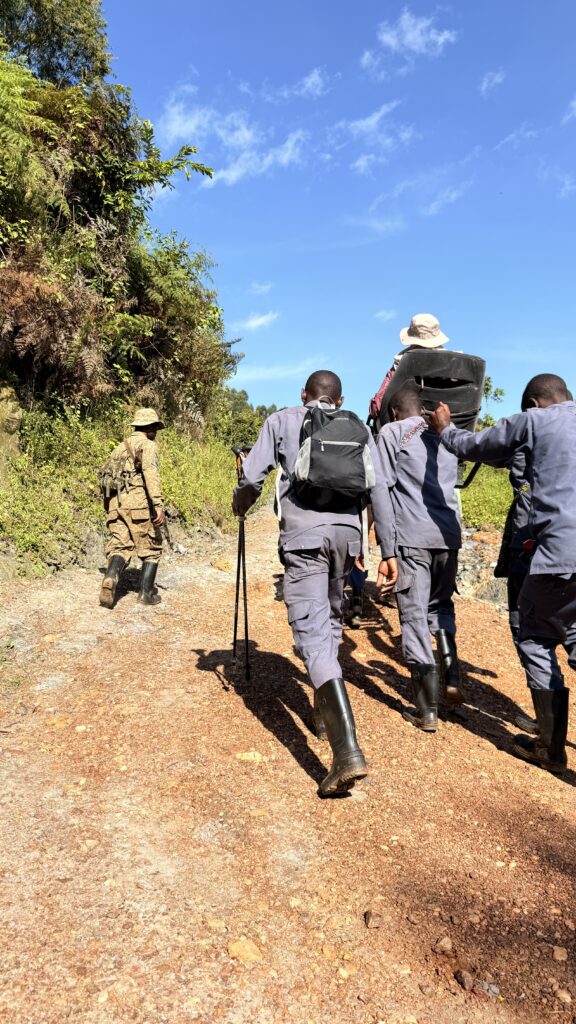
The lesson arrived in unexpected ways. Most dramatically, it arrived in the form of the “African Helicopter.”
A sturdy chair. Twelve porters. A steep mountain. And a decision.
For years, I would have rejected the option of this level of assistance. I would have told myself I should be able to do it on my own.
Instead, it became one of the most empowering experiences of the trip. Not because I was being carried. Because I allowed myself to be carried.
These men carried all of my weight, wonder, anticipation, and nerves up and down a rocky, rutted mountainside. At times they even ran.
Ran.
Down steep, rocky slopes while carrying a full-grown woman.
I still shake my head thinking about it. It was one of the most humbling and empowering experiences of my life.
That lesson echoed throughout the journey. Even the chimp trek carried the same invitation.
Eventually I stopped trying so hard to spot the chimpanzees. Instead, I sat on a fallen tree and listened. Calls echoed through the canopy. Branches cracked overhead. Rain dripped from the leaves. The forest was speaking. I hardly took any photos. For once, I wasn’t trying to capture the experience.
I was allowing the experience to capture me.
Participatory consciousness asks us to move beyond observation. Travel can easily become a spectator sport. As I collect photographs and gather stories.
Transformational travel asks something more. It asks us to enter the experience, to allow ourselves to be affected, and to become participants in the encounter.
We Belong to One Another
When people ask about Uganda, they usually ask about the gorillas, the safaris, and the wildlife.
And yes, those experiences were extraordinary. But when I close my eyes now, I remember something else.
I remember Sharon taking my hand. Children singing us into Murushasha. The porters carrying me up a mountain. A mother gorilla cradling her baby against her chest. A mother leopard bringing food to her cubs. Elephant mothers closing ranks around a young calf when two hyenas approached the herd.
My understanding of consciousness had expanded beyond awareness alone. It had become consciousness as relationship: to nature, to community, to other species, and to the living world itself.
I experienced the evolution of consciousness by entering more deeply into relationship with life.
Before leaving home, I promised myself that I would witness, feel, receive, and be changed. Uganda honored that prayer.
The lions, gorillas, and wildlife opened the door. The people walked me through it.
Uganda did not simply show me new landscapes. It revealed new ways of seeing, belonging, and participating in life itself.
If I pause now and breathe into the memory, I can still feel the lessons moving through me. The warm air through the jeep. The forest listening back. The Nile River carrying itself forward. The children’s voices rising in welcome.
The Sacred Journey to Uganda did not give me a final answer about consciousness. It gave me a living relationship with the question. And what I discovered there was surprisingly simple.
We belong to one another.
When we remember that, something in us softens. Something in us widens. Something awakens.
About the Author
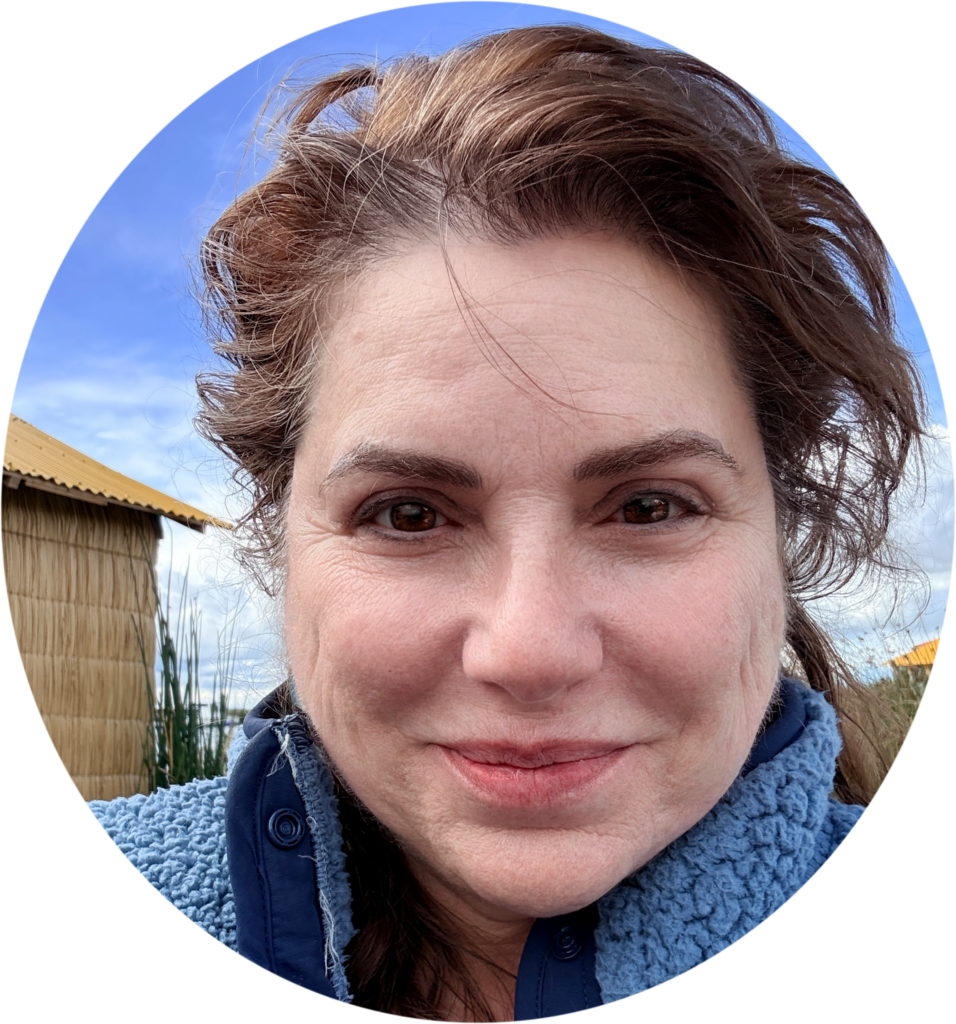
Donnamarie Mazzola is a longtime member of The Center of Peace in Philadelphia who joined her first Spirit Tours journey in November 2024. During the journey, inspired by the transformative experiences she encountered in Egypt, Donnamarie began weaving her reflections into original music that captures the essence of sacred travel.
Over time, her creative work has expanded to include lyrical narratives, visual storytelling, and multimedia projects that explore the intersection of travel and spirituality. Today, as a lifelong storyteller and creator, she brings her journeys to life through immersive and reflective experiences that invite others to see the world differently. In doing so, she encourages travelers to slow down, listen more deeply, and engage with sacred landscapes in a more meaningful way.
You can also listen to her songs about Obuntu and her travels in Africa on YouTube, where she shares the sensory and emotional essence of the safaris, gorilla trekking, and visiting the Murushasha school.
Share our Newsletter
Thank you for telling your friends about Spirit Tours. And when you join our newsletter referral program, you’ll also earn thank you rewards for sharing Journeys of the Soul with them.