
Sometimes spiritual mystery finds us in the most unexpected places.
Ten years ago, I visited my mother’s hometown, Benrath, a suburb of Düsseldorf, Germany. As a child, I often visited my family there, but it had been many years since I’d returned. My cousin walked us through places filled with childhood memories. Then we came to St. Cäcilia, the church where, she told me, my parents had married. I had no recollection of ever seeing it before.
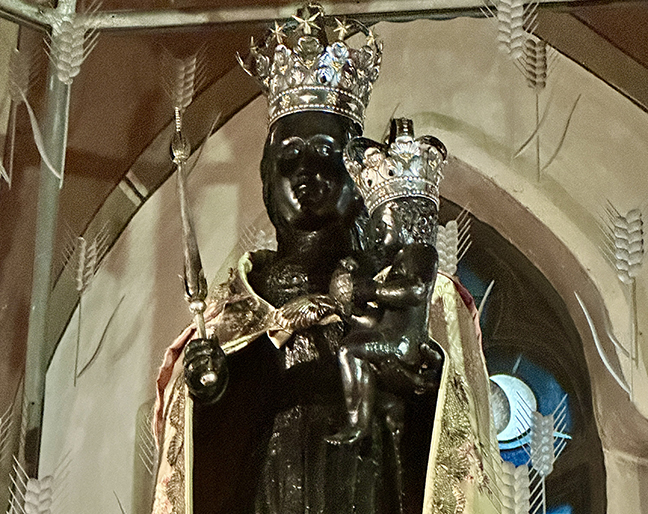
We went inside. A small chapel off to the side drew my attention, and I was stunned to find a five-foot statue of the Black Madonna encased in glass.
How did I not know this was here?
I have studied and taught metaphysical interpretations of the Bible for many years and have long been drawn to the Divine Feminine. How did I not know she was hiding in my own family’s history?
Tears leaked down my face. I felt overwhelmed, surprised, and moved beyond words. I didn’t know how to share any of this with my cousin, so I wiped my face, and off we went to lunch, leaving me wondering what had just happened.
A few years later, I returned to the chapel with my beloved and two best friends. We were all deeply committed to our spiritual journeys, and I couldn’t wait to show them whom I had discovered.
This time, I felt comfortable taking time to read the signs, look more closely at the symbols, and discuss my impressions openly. The chapel itself told an interesting story. I noticed few traditional Christian symbols. Instead, the glass case was etched with bees and sheaves of wheat. Small stained-glass windows showed a harvest, flowers, woodland, a star, a bird—not a cross or saint in sight.
We lit candles and sat in meditation. It was curiously peaceful and energetically quiet. I felt a stillness. I was simply present. And I had no idea what to make of her in this church where my mom grew up and my parents married.
What Does This Story Awaken in Me?
I still couldn’t explain what had happened in the chapel. But the experience had moved me without waiting for an explanation.
Sacred stories and sacred places do not have to surrender all their mysteries in order to transform us.
I had heard of the Black Madonna and read of possible associations with Mary Magdalene. I was intrigued, but I didn’t know how much of what I had heard was history and how much was legend. These are considered distinct figures, but in some legends and some places, they are seen as the same person.
The stories of Mary Magdalene, too, live in an intriguing space between history, tradition, legend, and faith. We can investigate what is historically knowable, and it matters that we distinguish history from legend. Yet eventually we arrive at questions for which certainty is not readily available.
What if that isn’t a problem to solve?
A Journey Into Mystery
Our spiritual journeys offer a powerful way of entering this in-between territory. We travel to places associated with stories told for hundreds or thousands of years. Sometimes we can establish what happened there. Sometimes we cannot. But standing in the place itself can invite an encounter different from either belief or proof.
Traveling in southern France, I encountered places associated with Mary Magdalene and centuries of devotion. There are things we know about her, traditions that have changed over time, and claims we cannot establish as historical fact. This is especially significant when considering how women’s stories have been told—or left out of history.
One of those places was the grotto of Sainte-Baume.
Reaching the grotto requires a substantial uphill walk through the forest. For about 45 minutes, a wide dirt path switches back along the mountainside. By the time I reached the top, I needed a moment to catch my breath.
There was something about that climb that felt like a pilgrimage in itself. Having made the effort to get there, I couldn’t help wanting the experience to be worthwhile.
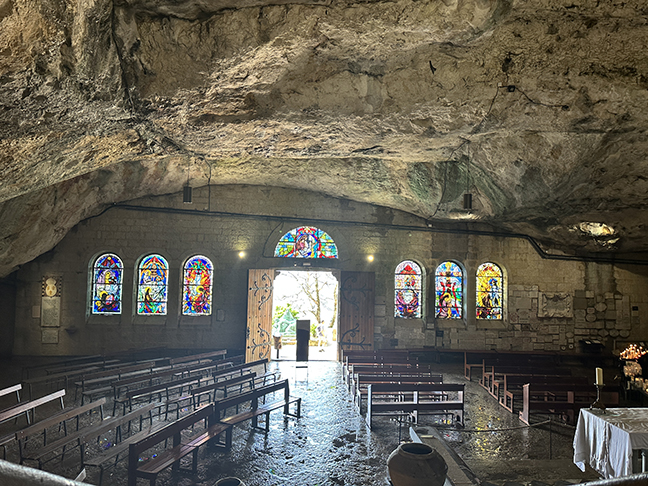
Inside, the grotto was immense, rising several stories into the darkness. The rocks were dark, and water dripped steadily in the background. An altar to Mary Magdalene stood toward the back, against the stone. The stillness was profound, though I wouldn’t describe it as peaceful. Nor was it sad or oppressive. There was something solemn about the space, a sense of time stretching far beyond my own presence there.
The water continued its slow movement against the rock, as it had for countless years. On a lower level, more water dripped near an altar remembering children who had died or never been born. There was a deepness to the experience that I still find difficult to put into words.
I didn’t feel pressed upon or overwhelmed. I was simply present, held within this enormous container of dark rock.
It was deep yet quiet, as my encounters with the Black Madonnas had been.
Encountering Spiritual Mystery
Rennes-le-Château offered a very different encounter with mystery.
There, stories of Mary Magdalene, the Knights Templar, lost treasure, and centuries-old symbols seemed to collide. Everywhere were suggestions of hidden meanings and connections. The legends were extraordinary, almost impossible to untangle from the history surrounding them.
I found myself caught between two familiar responses. I could believe the stories because they were so remarkable or dismiss them because they seemed impossible to substantiate.
But what if neither response was necessary? What if I could simply let the stories be what they were?
I didn’t have to decide whether every claim was real or true. I could allow myself to be in awe of what I was encountering. It was rather like seeing an extraordinary movie that you can hardly explain to someone afterward. You know you’ve been affected, even if you cannot fully say why.
At Rennes-le-Château, fact and legend seemed to crash into each other. Yet instead of demanding an answer, I found myself willing to let the mystery remain. I didn’t have to figure it all out.
Learning to Live with the Question
This willingness to encounter mystery without immediately analyzing it has been developing in me over many years.
By inclination, I am intellectual and academic. I like to understand things. I like to ask questions, examine ideas, and make sense of what I encounter. Those qualities have served me well. But I have also been cultivating another way of knowing.
It is rooted in the spiritual practice of contemplation.
In contemplation, we allow something to rest in our consciousness. We do not immediately question it, analyze it, or try to fit it into what we already know. We simply gaze upon it with a question mark in our minds.
Not even a fully formed question. Just a willingness to be present to what we do not yet understand. And then we allow it to reveal itself to us.
Sometimes what emerges is an insight, a feeling, an image, or a recognition we cannot quite name. Sometimes nothing happens that we can describe. The experience does not always need words.
This was the way I had begun to approach the sacred places I encountered. Each one deepened my willingness to be present without getting caught in the endless questions of what was real, what was legend, and what I was supposed to believe.
This does not mean abandoning discernment. We can honor the difference between history and legend without requiring either one to carry the whole weight of truth. I remember a Native American teacher beginning a story with the words, “I don’t know if it happened this way, but I know it’s true.” That distinction has stayed with me.
Mystery asks us neither to abandon discernment nor to manufacture certainty. It invites us to remain curious about what a story, symbol, or sacred place might reveal when we stop insisting that every question have an answer.
If we cannot prove that Mary Magdalene stood in a particular place, does that mean nothing can happen to us when we stand there?
If we cannot fully explain the origins or meaning of a sacred image, does that diminish what we experience in its presence?
These questions don’t replace historical inquiry. They begin where historical inquiry reaches its natural limits.
What Makes a Place Sacred?
Is it what happened there? What people believe happened there? Or the generations of people who have arrived carrying prayers, grief, gratitude, longing, and devotion?
Perhaps centuries of human attention leave something behind, whether we understand that spiritually, psychologically, communally, or in some way for which we don’t yet have language. Perhaps that is part of what these places hold for us.
At Sainte-Baume, I had felt the stillness of the enormous grotto and the slow movement of water against stone. At Rennes-le-Château, I had encountered stories whose competing claims I could not reconcile. In Germany, I had stood unexpectedly before a Black Madonna in a church woven into my own family’s history.
None of these experiences required me to reach a conclusion before I could be moved by them.
And perhaps that is one of the gifts of spiritual travel. We temporarily leave the world in which everything is expected to be explained and enter landscapes where human beings have been living with unanswered questions for centuries.
The Gift of Presence
Now, when I encounter the Black Madonna, I do not need to understand, analyze, or explain who she is or how she came to be. Rather, I seek to be present—present to her presence.
Practicing presence invites us to stop narrating our lives to ourselves and simply pay attention to what is before us. It requires the art of letting something speak to us rather than us speaking about it.
We can notice how an encounter lands in the body, what it stirs in our emotions, and what it opens in the mind, without rushing to name it.
As I stand in my memory before the Black Madonna in that church in Germany, once again my eyes fill.
Why? I’m not really sure.
Maybe it’s the recognition of the Divine Feminine.
Maybe it’s seeing my love for nature reflected in the tradition I grew up in, or that parts of me are being reclaimed that I didn’t even know were missing.
Perhaps I don’t need to know what it is, just that it is. Each symbol speaks; each moment moves me. And if I can’t give it words or tell you the meaning behind it, that makes it no less powerful an experience for me.
And perhaps this is at the heart of a sacred journey: allowing mystery to meet us, without demanding that it explain itself.
Being present to what is before us.
And that may very well be enough.
About the Author
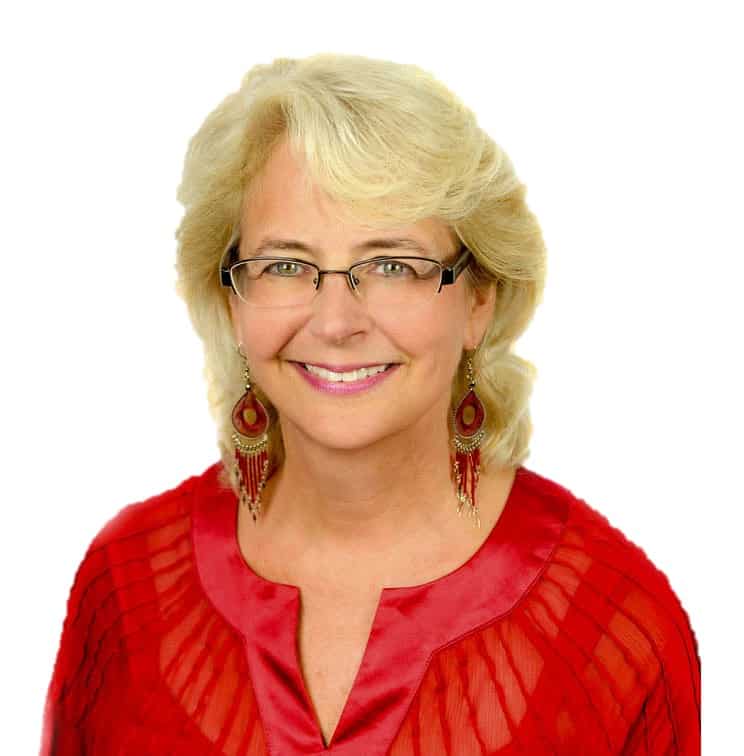
Rev Dr Petra Weldes is the Co-owner of Spirit Tours. Dr. Petra recently retired as the Spiritual Leader of CSLDallas, a role she held since 1998. She is a gifted speaker, teacher, and interfaith leader who brings heart, humor, and insight to everything she does. Over more than four decades, her work has inspired thousands to live with greater joy and spiritual awareness.
An award-winning minister and author, Dr Petra has led workshops and retreats around the world, helping people connect with their purpose and inner wisdom. She has also created courses on practical spirituality and co-authored three journals on living with joy. Through her teaching and storytelling, she creates welcoming spaces where people can explore, grow, and truly feel at home on their spiritual journey.
Share the Journey
If this reflection resonated with you, share it with someone who might enjoy traveling more deeply. When you invite friends to subscribe to Journeys of the Soul, you’ll also earn thank-you rewards through our newsletter referral program.