
Is spiritual travel religious? The question sounds simple enough. But after more than 20 years of traveling with Spirit Tours, I’ve discovered that the answer is much more interesting when we experience it than when we try to define it.
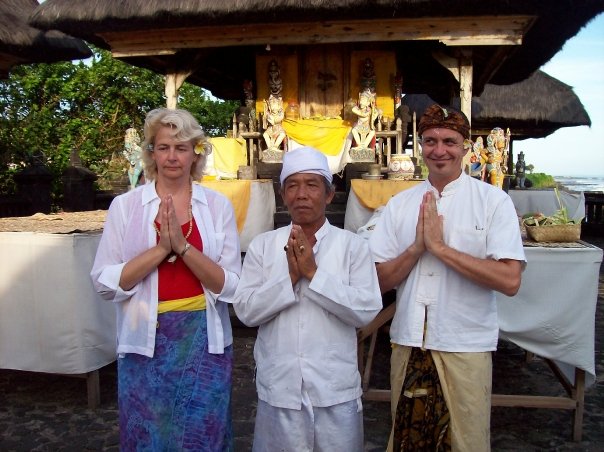
The first time I participated in temple rituals in Bali, at Pura Goa Lawah—the Bat Cave Temple—I remember feeling weird and out of place.
I didn’t understand a word the priest was chanting. Everything was different from what I was used to. I couldn’t help noticing the worn coverings on the statues and wondering if, at any minute, the bats would fly out. Sitting in the outdoor temple was hot and sweaty.
Was I having a spiritual experience? I wasn’t so sure.
When I Stopped Trying to Understand
At our next temple, dedicated to Saraswati, the Hindu goddess of knowledge, wisdom, music, the arts, and learning—all my favorite things!—something began to change.
Once again, we were invited into a sacred space. Once again, I didn’t understand the chanting. We sat for nearly an hour in meditation on hard stones while the priest blessed us with holy water and rice. And yes, once again, it was very hot and humid and sweaty.
But this time I caught myself. I thought, Well, I can resist and analyze the whole thing again, or I can just melt into the experience.
What a relief it was to let go and simply be present. I still didn’t understand the words or fully understand the ritual. Yet somehow, the hour flew by.
Afterward, I found myself drawn to a statue of Saraswati in the middle of a large reflecting pool. I sat there until it was time to leave, silently communing with a presence in a way that was new for me.
I’m not one for gurus or photos on my altar. But something spoke to me about Saraswati’s connection to learning, knowledge, music, and the arts. These things, too, were part of my spiritual path.
I felt seen. I felt connected to something larger than myself. And I didn’t have to become Hindu for any of that to happen.
So, Is Spiritual Travel Religious?
The shortest answer is no. Spiritual travel may include religious places, practices, ceremonies, and traditions. But it does not require travelers to belong to a particular religion or share a common belief system.
Nor does “spiritual” mean “anti-religious.”
For many people, religion is where they experience God, belonging, transcendence, and the sacred. Religious traditions have also created and preserved many of the temples, churches, monasteries, pilgrimage routes, rituals, and stories we encounter as travelers.
But people come to spirituality in many other ways, too.
For some, spirituality is a relationship with God or the Divine. For others, it is expressed through prayer, meditation, or consciousness. Some find the sacred most readily in nature. Others discover it through human connection, creativity, service, or those mysterious moments when we suddenly feel part of something much larger than ourselves.
Traveling to sacred sites, experiencing local practices, engaging in personal reflection, and having deep conversations with fellow travelers can invite us to explore our own deepest beliefs about who we are, the nature of the Universe, and what life is all about.
We don’t all need to come to the same conclusions.
Perhaps the more interesting question is this: If we don’t agree on what makes something sacred, how can we experience the sacred together?
What Makes a Place Sacred?
Maybe there isn’t one answer.
Some places have been prayed in, grieved in, celebrated in, and returned to for hundreds or even thousands of years. Generations of human beings have invested them with meaning.
Sometimes we enter those places because they are sacred to us. At other times, we enter because they are sacred to someone else. That distinction matters.
Being a guest in another person’s sacred world asks something of us. We don’t have to adopt another person’s beliefs to honor what they hold sacred. We can listen. Observe. Learn. Participate when invited. Allow ourselves to be affected.
But sacredness isn’t found only in temples and churches. I have experienced connection, awareness, and deeper purpose walking through the rainforests of Costa Rica, watching seals and dolphins around the Aran Islands of Ireland, and standing in awe of the majestic mountains of New Zealand.
So perhaps sacredness also has something to do with the way we meet a place.
A temple can be another stop on an itinerary. A mountain can be scenery. A walk can simply get us from here to there.
Or we can slow down. Pay attention. Become curious. Let the experience come to us before deciding what it means.
Maybe sacredness comes partly from place and partly from intention. Maybe it emerges through attention or relationship. Or perhaps the sacred was there all along, and what changes is our capacity to recognize it.
I’m not sure we need to settle that question.
Subscribe to our newsletter for twice-monthly reflections, spiritual travel insights, and first looks at new tours.
Sacred Travel Doesn’t Tell You What an Experience Must Mean
Years after that first Bali journey, another Spirit Tours experience brought this home in a very different way.
We had trekked to the Grotte de la Sainte-Baume in Southern France, traditionally associated with Mary Magdalene. The grotto is an ancient natural place, tucked into the mountain, and for many pilgrims it carries a powerful sense of Mary Magdalene’s presence.
Later, as our group shared our experiences, two women described encountering the same place very differently.
One had loved the grotto. She felt deeply connected to Mary Magdalene and to the altar honoring her within that ancient cave.
The other woman had been frustrated. For her, entering a place dedicated to Mary Magdalene and first encountering prominent images and an altar to Jesus raised questions about patriarchy. She wondered about the ways women’s sacred stories and spaces have been framed through male religious traditions.
The first woman had been able to see beyond those elements—or perhaps had barely noticed them. What she experienced was Mary’s presence.
Neither experience needed to cancel the other.
The conversation wasn’t about deciding who had understood the grotto correctly. Each woman had brought her own history, awareness, beliefs, and sensitivities into that cave. Each had encountered something real for her.
That is part of what happens when we travel together. We may stand in the same place, participate in the same ceremony, or sit in the same meditation and have entirely different experiences. Later, when we share them, I may notice something through your eyes that I never saw through my own.
That doesn’t diminish my experience. Instead, it enlarges the journey.
What Does Sacred Travel Ask of Us?
If sacred travel doesn’t require a particular theology, it does ask something else of us.
It asks us to treat the journey itself as part of our spiritual practice.
Spiritual travel invites us to take every moment—whether we’re in a temple, at the airport, talking over coffee, or taking a walk by ourselves—as an opening. The sacred experience isn’t necessarily the one printed on the itinerary.
Sometimes it may be an uncomfortable encounter or a challenging person.
Those moments invite us to ask whether we are actually living according to our own spiritual beliefs and practices. Are we kind to people? Are we generous toward what we don’t understand? Are we willing to examine our discomfort for hidden judgments, assumptions, or the expectation that everyone should think and live as we do?
Sacred travel invites us into humility and presence. It also encourages us to become courageous about our own convictions and beliefs.
We don’t have to take up something foreign as our own. We don’t even have to understand everything we encounter.
But we can let it work on us. We can pay attention. Become curious. Notice our reactions. Make room for someone else’s experience to be different from ours. And sometimes, in doing so, we discover something about ourselves.
The Sacred Can Find Us in Unexpected Places
On that first Bali journey, this became deeply personal for me.
Our final temple experience was at Tanah Lot, dramatically surrounded by the waters of the Indian Ocean. We stopped at the sacred spring to receive rice and the blessing of holy water before entering the sacred space.
By then, something had shifted in me.
I eagerly approached the holy man who would lead us in meditation. He and I looked into each other’s eyes, and I was cracked wide open. We hugged. We spoke words neither of us could understand. And somehow, we connected.
Later, surrounded by the wind and waves, I sat as others began to leave. I found myself sobbing, finally releasing the grief I carried over my mother’s passing.
I had been too busy to properly let the grief out. But here, it was safe.
The wind and the waves carried my sadness for me, and I felt less alone.
Was it the temple? The ritual? The holy man? The ocean? My own readiness to finally stop resisting?
Perhaps all of it. Perhaps none of those things can be separated from the others.
What I know is that my first trip to Bali showed me what spiritual travel could offer when I was willing to become available to it.
Why Travel This Way with Other People?
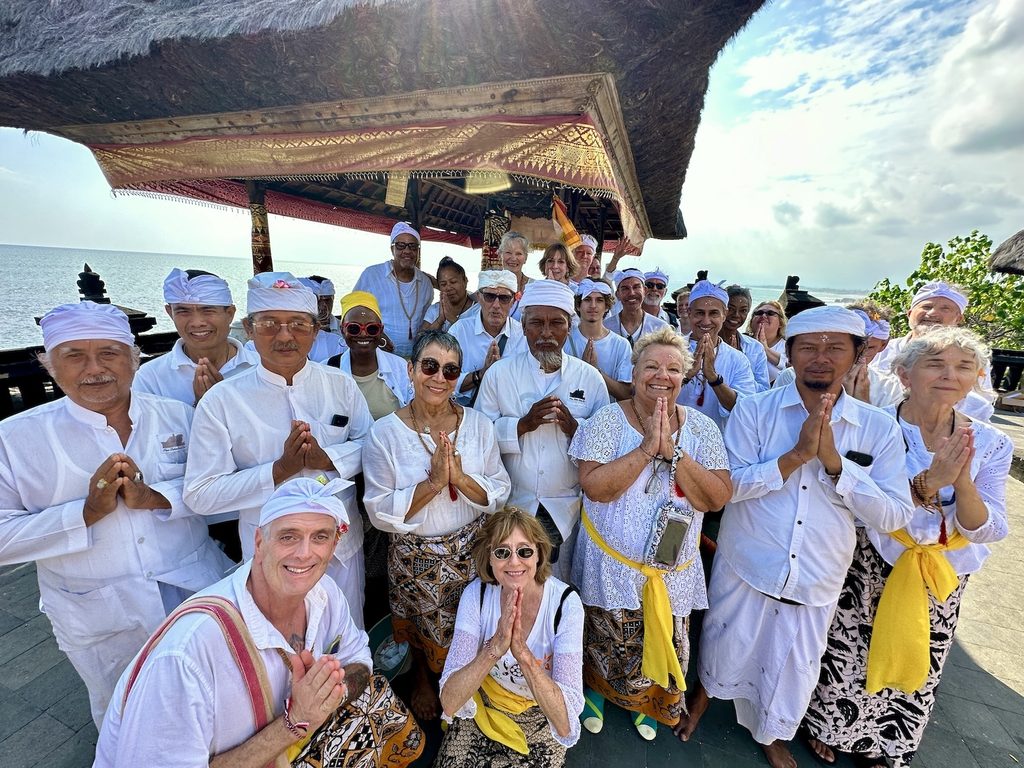
I was never a group traveler. I preferred to avoid the crowds, the complainers, and those who travel but never really leave home. And yet, I’ve now been traveling with Spirit Tours for more than 20 years.
Each journey has offered something unique. Each tradition, culture, and country has expanded my horizons and deepened my awareness. And each group has become a circle within which I’ve experienced laughter, tears, and deep wisdom.
Spirit Tours carefully curates both the itinerary and opportunities for reflection and conversation. We travel outward into cultures, landscapes, and traditions, but we are also invited to notice what is happening within ourselves.
The point is not for everyone in the circle to believe the same thing. It is not even for everyone to have the same experience.
Sometimes one person loves what another person dislikes. Sometimes an experience produces a profound personal insight for one traveler and very little for someone else. Sometimes hearing what another person noticed allows us to see an experience from an entirely new perspective.
Everything is geared toward accepting that each person is having their own experience. Their experience belongs to them.
And yet we are not traveling alone. There is something powerful about becoming connected not because everyone agrees, but because we have agreed to pay attention together.
You Don’t Have to Believe What I Believe to Belong
For someone considering a sacred journey for the first time, perhaps this is the most important thing to know.
You don’t need to arrive with the “right” spiritual vocabulary. You don’t need to practice a particular religion. Nor do you need to believe what your trip leader believes or what the person sitting next to you believes.
You can bring your own understanding. And what matters is that you also make room for someone else’s.
For me, spiritual travel has become a practice of traveling as consciously as I can—open to what is offered, reflecting on my experiences, and finding connection wherever I go.
Every journey has had its moments: soft and powerful, sacred and silly, connected and self-aware.
So, is spiritual travel religious?
It can certainly bring us into relationship with religion. It can lead us into temples, churches, rituals, and traditions that have carried people’s faith for centuries.
But spiritual travel asks a different question. Not “Do we all believe the same thing?” But perhaps: “Are we willing to become available to what we might encounter?” To a place, to another person, to a different way of seeing. Or to something sacred we may not yet have words for.
And, ultimately, to a deeper encounter with ourselves.
About the Author

Rev Dr Petra Weldes is the co-owner of Spirit Tours. Dr. Petra recently retired as the spiritual leader of CSLDallas, a role she held since 1998. She is a gifted speaker, teacher, and interfaith leader who brings heart, humor, and insight to everything she does. Over more than four decades, her work has inspired thousands to live with greater joy and spiritual awareness.
An award-winning minister and author, Dr Petra has led workshops and retreats around the world, helping people connect with their purpose and inner wisdom. She has also created courses on practical spirituality and co-authored three journals on living with joy. Through her teaching and storytelling, she creates welcoming spaces where people can explore, grow, and truly feel at home on their spiritual journey.
You May Also Like
- What Is Spiritual Travel? (And How Is It Different from Tourism?)
- What Makes Spiritual Travel Transformational?
Who Comes to Mind?
Share the Spirit Tours emails that inspire you with someone who might feel called to journey with us—and earn rewards along the way.